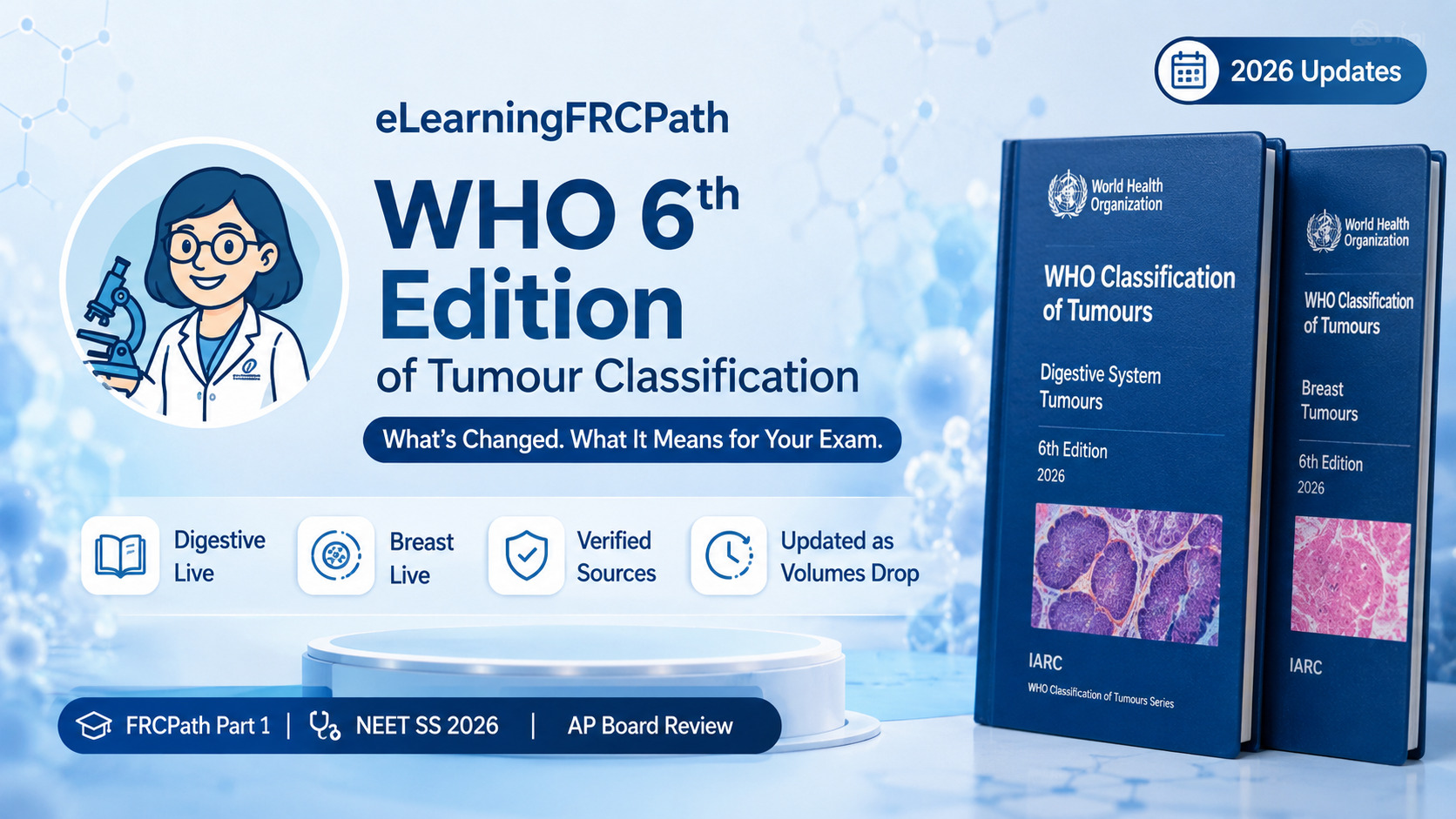
What is the WHO 6th Edition of tumour classification?
If you sit any pathology exam anywhere in the world, this is the reference standard you're being tested against.
The WHO Classification of Tumours — the "Blue Books" — is how tumours get named, defined and graded across the globe. When a paper, a report, or an exam question says "per WHO classification," this is the document it means. It's not a UK thing or an India thing; FRCPath, ABPath, NEET SS, FCPS and the Gulf DHA exams all lean on it. So a new edition isn't a niche update — it's the ground shifting under every diagnostic pathologist at once.
The 5th Edition rolled out volume by volume from 2019 to 2024. The 6th Edition began releasing in 2026, and it's a bigger series: expanding to 14 volumes, up from the 5th Edition's set. Two of those additions are brand new — a dedicated Paediatric Tumours volume and a Genetic Tumour Syndromes volume, neither of which existed as standalone books before.
The 6th Edition is being published first as an online beta at tumourclassification.iarc.who.int (subscription required), with print "Blue Books" following from IARC/WHO. The Digestive System volume's online beta went live January 30, 2026, with the print book scheduled for Spring 2026.
Two volumes are out so far, and they happen to be two of the highest-yield organ systems on any pathology exam. That's what makes this worth your attention now rather than later. If you're building your foundation, our FRCPath Part 1 course stays aligned with the WHO standard your exam actually tests.
WHO 6th Edition digestive system tumours — what changed
The first volume out, and the most restructured. Here's the verified breakdown.
The 6th Edition of the Digestive System volume is a genuine reorganisation, not a light refresh. The headline structural move: epithelial tumours are now organised by anatomical site rather than mixed together, and neuroendocrine, mesenchymal and haematolymphoid tumours each get their own dedicated chapters — bringing this volume in line with the rest of the WHO series. Genetic tumour syndromes are now classified by mechanism, pathway and gene rather than by organ, and metastatic disease gets proper coverage under a consolidated "other tumours and metastases" section.
New entities added
These are the exact names to know — several are entirely new to the classification.
- NewOesophageal epidermoid metaplasia — now a separate section
- NewColorectal intramucosal adenocarcinoma
- NewLow-grade tubuloglandular adenocarcinoma
- NewLymphoglandular complex-like adenocarcinoma
- NewIntraductal tubulopapillary neoplasm of the bile ducts
- NewIntraductal oncocytic papillary neoplasm of the bile ducts
- NewSonic hedgehog hepatocellular adenoma
The conceptual changes worth memorising
A few shifts change how you think, not just what you name. Amphicrine-like carcinoma (ALC) is now distinguished from MiNEN, broadening how we understand tumours with dual neuroendocrine and non-neuroendocrine differentiation. Grading has been simplified to two-tier (low grade / high grade) classifications across precursor lesions, with enhanced criteria for neuroendocrine tumour grading. The approach to metaplastic and dysplastic gastric lesions has been modified, "undifferentiated carcinoma" has been redefined with clearer criteria, and dysplasia/precursor approaches have been unified.
The 6th Edition adds coverage that simply wasn't there before: immune checkpoint inhibitor–associated injury patterns, rituximab-associated upper GI mucosal alterations, and CAR-T cell therapy–associated changes that can mimic infectious or immunologic disease. If you're being examined on iatrogenic and treatment-effect pathology, this is new testable territory.
What it means for you: don't try to relearn GI pathology from scratch. Anchor on the 5th Edition, then layer the new entity names and the two-tier grading logic on top as "what's new" knowledge. Examiners love a candidate who can name a recently added entity. Want to test yourself? Practice board-style questions or download our free 199 MCQs.
Source: Arends MJ et al. Changes in the 6th edition of the WHO Classification of Tumours of the Digestive System. Histopathology 2026;88(7):1295–1314. DOI: 10.1111/his.70116
WHO 6th Edition breast tumours — what changed
Prepared by 112 authors, with one change almost guaranteed to show up on your exam.
The Breast volume went live as an online beta in April 2026, prepared by 112 authors and editors and backed by high-quality images, slide images and 2,900 references. The single most exam-relevant change is in HER2.
HER2 reporting categories have been updated following the DESTINY-Breast 04 and 06 trials. HER2-low is now a clinically actionable category — which is a big deal, because HER2 scoring is one of the most frequently tested topics on FRCPath, NEET SS and ABPath. A candidate who doesn't know this change is genuinely at risk.
The other key changes
- NewInvasive lobular carcinoma (ILC) with extracellular mucin — recognised as a new diagnostic entity with prognostic implications
- Terminology"Variant" — the term is now reserved for molecular/genetic alterations only
- ReportingBiomarker categorisation — pathology reporting modified to reflect new treatment regimens
- ScopeGlobal relevance — classification updated for use across health systems
What it means for you: if you take one thing from the breast volume into the exam hall, make it the HER2 reporting update. Understand why HER2-low exists as a category and what the DESTINY-Breast trials changed clinically. It's the kind of "recent, high-impact, clinically actionable" change examiners reach for. This applies whether you're sitting FRCPath, the NEET SS Pathology 2026 guide exam, or US boards — see how they line up in our comparison of pathology board exams globally.
Source: Quinn C et al. WHO Classification of Tumours of the Breast, 6th edition 2026. Histopathology 2026. DOI: 10.1111/his.70149
What's coming next in the WHO 6th Edition rollout
Digestive and Breast are done. Everything below is expected but not yet released as of July 2026.
Based on the 5th Edition's release pattern, these volumes are anticipated in the 6th Edition. Timing isn't officially confirmed — treat this as the roadmap, not a schedule. Two of them (marked new) didn't exist as standalone volumes in the 5th Edition at all.
We update this page as each volume lands, so bookmark it and check back when your organ system drops. In the meantime, keep your foundations sharp with AP board review resources.
Will the WHO 6th Edition be tested on my exam?
The question everyone's asking. Here's the honest answer, exam by exam — no speculation dressed up as fact.
FRCPath — Autumn 2026
Not confirmedRCPath has not announced whether the Autumn 2026 exam will include 6th Edition content, and the 5th Edition is still the current standard for the current exam format. The new exam format (Spring 2027 onwards) may incorporate 6th Edition updates.
Safe advice: Know the 5th Edition as your primary reference. Be aware of the 6th Edition digestive and breast changes — they may surface as "recent updates" questions.
NEET SS — December 11–12, 2026
Not specifiedNBEMS has not specified which WHO edition the 2026 exam follows. For context: the Digestive volume released in beta in January 2026 (11 months before the exam) and the Breast volume in April 2026 (8 months before).
Safe advice: Prepare primarily with the 5th Edition. Know the major GI and Breast 6th Edition changes as "what's new" topics — NEET SS is fond of testing awareness of the latest updates.
ABPath AP — Fall 2026 (October 5–19)
Not specifiedABPath has not specified a transition to the 6th Edition for Fall 2026. The exam blueprint references WHO classification but doesn't pin an edition.
Safe advice: 5th Edition as your base, 6th Edition awareness as a competitive advantage.
FRCPath — Spring 2027 (new format)
PossiblyThe new exam format from Spring 2027 onwards may incorporate 6th Edition updates. Nothing is confirmed yet, but this is the sitting most likely to reflect the transition.
WHO edition transitions take 1–2 years to fully filter into exams. The 5th Edition was published from 2019–2024, and it took until 2021–2022 for exams to consistently test it. The 6th Edition will likely follow the same curve. But candidates who know the changes now hold a real edge — examiners use "what's new" questions to spot the people who stay current.
WHO 5th vs 6th Edition — key differences at a glance
Side by side, for the two volumes actually released. Scroll the table sideways on mobile.
| Aspect | 5th Edition | 6th Edition (2026) |
|---|---|---|
| Number of volumes | Established set of volumes (2019–2024) | Expanding to 14 volumes, incl. new Paediatric & Genetic Tumour Syndromes books |
| Digestive — structure | Epithelial tumours mixed; less separation of tumour classes | Organised by anatomical site; dedicated neuroendocrine, mesenchymal & haematolymphoid chapters |
| Digestive — grading | Multi-tier grading of precursor lesions | Simplified two-tier (low / high grade) across precursors |
| Digestive — new entities | — | Adds colorectal intramucosal adenocarcinoma, bile-duct intraductal neoplasms, Sonic hedgehog HCA and more |
| Digestive — treatment effect | Limited coverage | New section: checkpoint inhibitor, rituximab & CAR-T–associated pathology |
| Breast — HER2 | HER2 positive / negative reporting | Updated categories incorporating HER2-low (DESTINY-Breast 04/06) |
| Breast — new entity | — | ILC with extracellular mucin recognised as a distinct entity |
| Breast — terminology | "Variant" used more broadly | "Variant" reserved for molecular/genetic alterations only |
For a deeper look at how these classifications map onto different exams, our guide comparing pathology board exams globally breaks down what each body actually expects.
How our courses are adapting to the 6th Edition
Straight answer: our content is currently aligned with the WHO 5th Edition — the standard tested on all current exams. That's deliberate, not dated. As 6th Edition volumes are released, we review and integrate the clinically significant changes into our notes, MCQs and lectures, and candidates using the platform receive those updates as they become exam-relevant. You prepare against what your exam actually tests today, and you're kept current as the transition happens.
If you're deciding where to start, the FRCPath Part 1 histopathology course is WHO-aligned preparation, and there are region-specific routes too — the FRCPath from India guide and the FRCPath from Pakistan guide. Already through Part 1? Here's what to do after passing FRCPath Part 1. Weighing whether pathology is the right long game? Read up on pathology career scope in India.
WHO 6th Edition — frequently asked questions
What is the WHO 6th Edition?
The WHO Classification of Tumours — the "Blue Books" — is the global reference standard for how tumours are named, defined and graded. The 6th Edition is the latest series, releasing from 2026 onwards, expanding to 14 volumes and updating diagnostic criteria across organ systems. It's the standard that pathology exams worldwide test against.
Which volumes are released so far?
Two are out as online beta: Digestive System Tumours (January 30, 2026) and Breast Tumours (April 2026, prepared by 112 authors and editors). More volumes are expected as the series rolls out, including brand-new Paediatric Tumours and Genetic Tumour Syndromes books.
Is it free to access?
No. The 6th Edition online beta is at tumourclassification.iarc.who.int but requires a subscription. Print "Blue Books" are sold separately by IARC/WHO.
Will FRCPath test the 6th Edition in 2026?
Not confirmed. RCPath hasn't announced whether the Autumn 2026 exam will include 6th Edition content, and the 5th Edition remains the current standard. Being aware of the digestive and breast changes is still worthwhile — they may appear as "recent updates" questions. The new format from Spring 2027 may incorporate the 6th Edition.
Will NEET SS test the 6th Edition in 2026?
Not specified. NBEMS hasn't stated which WHO edition the December 2026 exam follows. Prepare primarily with the 5th Edition and know the major GI and Breast 6th Edition changes as "what's new" topics — NEET SS often tests awareness of the latest updates.
What are the biggest changes in digestive system pathology?
Epithelial tumours are reorganised by anatomical site, grading is simplified to two-tier (low/high grade), several new entities are added, amphicrine-like carcinoma is distinguished from MiNEN, and a new section covers immunotherapy-related pathology — checkpoint inhibitor, rituximab and CAR-T–associated changes.
What changed in breast HER2 reporting?
HER2 reporting categories were updated following the DESTINY-Breast 04 and 06 trials, so HER2-low is now a clinically actionable category. The 6th Edition also adds invasive lobular carcinoma with extracellular mucin as a new entity, and reserves the term "variant" for molecular/genetic alterations only.
Should I buy the new Blue Books?
For most 2026 exam candidates it's not essential yet — the 5th Edition is still the tested standard. If your organ system's 6th Edition volume is out and you want to stay current, subscription access or the relevant print volume can help, but keep your core preparation on the 5th Edition.
How is this different from the 5th Edition?
The 6th Edition expands to 14 volumes, reorganises content by anatomical site and mechanism, simplifies grading to two-tier systems, updates biomarker reporting (notably HER2), adds new entities, and introduces immunotherapy-related pathology sections that weren't in the 5th Edition.
Will your courses be updated for the 6th Edition?
Our content is currently aligned with the WHO 5th Edition — the standard tested on all current exams. As 6th Edition volumes release, we review and integrate clinically significant changes into our notes, MCQs and lectures, and candidates receive those updates as they become exam-relevant.
Sources and references
- Arends MJ et al. Changes in the 6th edition of the WHO Classification of Tumours of the Digestive System. Histopathology 2026;88(7):1295–1314. DOI: 10.1111/his.70116
- Quinn C et al. WHO Classification of Tumours of the Breast, 6th edition 2026. Histopathology 2026. DOI: 10.1111/his.70149
- ICCR announcement. New WHO Classification for Digestive System Tumours online (January 31, 2026).
- ICCR announcement. New WHO Classification for Breast Tumours online (April 10, 2026).
- IARC Publications. WHO Classification of Tumours online — tumourclassification.iarc.who.int
- WHO Blue Books official site. whobluebooks.iarc.fr